Most candidates picking a road test site in South Florida ask one question: which office is closest to home? That is a reasonable starting point, but it is not the whole picture. Miami-Dade and Broward handle Class E road tests through different government agencies, book appointments through separate portals, and send candidates onto road environments that are genuinely unlike each other. Before you lock in a date, it is worth understanding what you are actually choosing - because Florida gives you full latitude to choose.
The Rule Most Candidates Do Not Know
Florida has no county residency requirement for the Class E skills test. Any Florida resident can schedule and take a road test at any DHSMV-authorized site in the state, regardless of which county they live in. The license that comes out the other side is a state document - issued by DHSMV, valid in every county, carrying no marker of where the test was taken.
This matters because it reframes the decision entirely. You are not locked into the nearest office. You are choosing among real options that differ in scheduling pressure, road environment, administering agency, and parallel parking setup. Crossing the county line for your test is fully legal - and for many candidates, it is the smarter move once they understand what they are actually comparing.
Two Counties, Two Different Administering Agencies
Here is where Miami-Dade and Broward diverge structurally. In Miami-Dade, road tests run through a mix of DHSMV-operated offices and Miami-Dade Tax Collector locations. In Broward, road tests are administered entirely by the Broward County Tax Collector under a Florida statutory agreement authorizing county tax collectors to conduct driver license transactions on behalf of DHSMV - not by a DHSMV-operated office at all.
That administrative split produces real downstream differences:
- Scheduling portals: DHSMV-operated Miami-Dade sites use the DHSMV Virtual Office at services.flhsmv.gov/virtualoffice. Broward Tax Collector appointments go through a separate system at broward.org. The two counties share no unified queue.
- Walk-in policies: Broward Tax Collector offices set their own daily cut-off times and walk-in rules under their own administrative infrastructure. Miami-Dade DHSMV offices operate under DHSMV procedures. Neither county guarantees same-day walk-in testing, but their specific policies can differ - call ahead before driving over unannounced.
- Fees: The Class E road test fee is set statewide by DHSMV - check flhsmv.gov for the current amount. Total transaction costs can differ slightly between DHSMV-direct offices and Tax Collector offices depending on each office's service fee schedule. Confirm what you will owe before your appointment.
- Holiday schedules: Tax Collector offices and DHSMV offices do not always share the same closure calendar. Verify your appointment date directly, especially around state and federal holidays.
Miami-Dade Test Sites and Their Road Environments
Miami-Dade has multiple road test locations spread across the county. The Northside Driver License office sits in northwest Miami near NW 27th Ave, a six-lane urban arterial carrying heavy commercial truck traffic and Miami-Dade Transit Metrobus service. A Hialeah Tax Collector site serves the dense west-suburban grid of that city. Kendall-area sites serve the southern suburbs along the US-1 corridor.
What Each Area Actually Drives Like
The road environment around each site shapes what the test route demands:
- The Northside area puts candidates on wide multi-lane roads with signalized intersections every few blocks, heavy pedestrian activity near bus stops, and commercial driveways where trucks pull in and out without warning.
- Hialeah routes run through a tight residential and commercial grid with frequent stop signs, narrow lanes on some blocks, and cyclists sharing the road - a high-attention urban environment that punishes candidates who stop checking mirrors.
- Kendall-area routes tend to involve suburban six-lane arterials with coordinated signal timing and fewer pedestrian crossing events than central Miami - still clearly urban South Florida, but with more predictable lane flow.
DHSMV does not publish official route maps. Examiners adjust paths based on traffic conditions on the day. What you can count on is the character of the surrounding network - and in Miami-Dade, that character is consistently dense and signalized regardless of which specific site you test at.
Broward Test Sites and Their Road Environments
Broward County Tax Collector road test sites operate in Pembroke Pines, Lauderhill, Hollywood, and other municipal areas. The physical road environment around most Broward sites is materially different from Miami-Dade's urban core - and that difference is worth being specific about.
Pembroke Pines routes use wide suburban arterials including segments of Pines Boulevard and Flamingo Road - roads laid out in the planned suburban expansion of western Broward during the 1980s and 1990s. These roads carry traffic at speeds considerably higher than a typical Miami side street, with fewer intersections per mile, lower pedestrian density, and more straightforward lane-change situations. Lauderhill routes run through a mix of older residential grids and commercial strips that sit somewhere between Pembroke Pines's open suburban feel and the denser urban character of central Fort Lauderdale.
The practical implication: a candidate who is confident at higher speeds on wide roads but uncomfortable with stop-and-go urban signalized intersections may find a Broward suburban route less disruptive. That is not a recommendation to avoid Miami-Dade - it is usable information for matching the test environment to your current driving strengths.
Route Environment: The Real Comparison
Naming specific streets makes the contrast concrete instead of abstract. A test route from the Northside area of Miami-Dade might include a multi-lane left turn at a signalized intersection with protected/permissive signal phases, a right turn across a bus lane or bike lane, a residential block loop with tight sight lines, and merging from a side street onto an arterial with limited visibility. A Broward suburban route from Pembroke Pines might involve a wide-lane right turn onto an arterial, a single lane change at posted speed, a residential loop at low speed, and one or two signalized intersections - at substantially lower pedestrian and cross-traffic density throughout.
| Factor | Miami-Dade (central sites) | Broward (suburban sites) |
|---|---|---|
| Road type | Dense urban arterials, residential grids | Wide suburban arterials, planned grids |
| Signal density | High - frequent intersections | Lower - longer blocks between signals |
| Pedestrian activity | Higher, especially near transit stops | Lower at most suburban sites |
| Posted speeds | Generally lower on surface streets | Higher on wide arterials |
| Administering agency | DHSMV or Miami-Dade Tax Collector | Broward County Tax Collector only |
| Primary booking portal | services.flhsmv.gov/virtualoffice | broward.org |
The Parallel Parking Variable No One Talks About
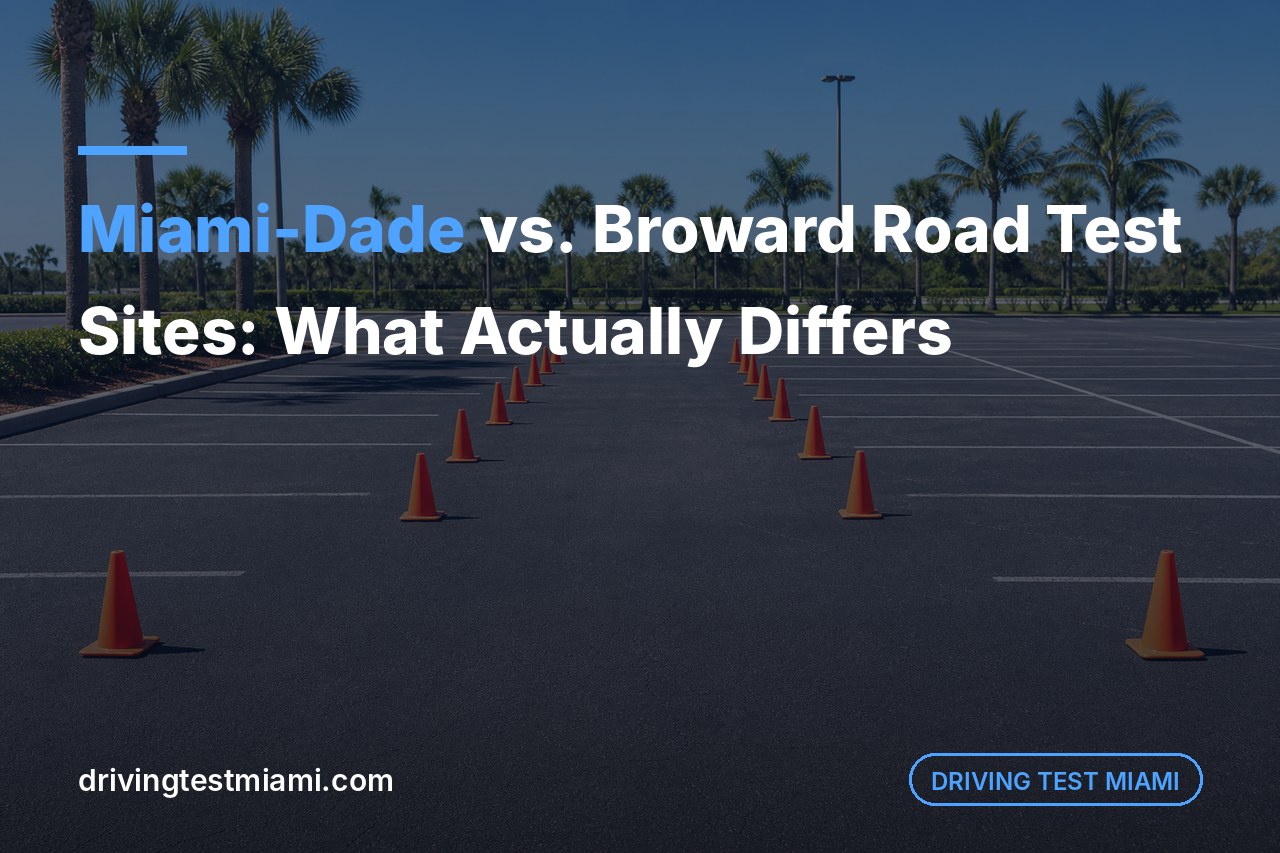
Parallel parking is required on every Florida Class E road test - statewide and non-negotiable. What is not standardized is the physical setup used to test it. At some sites, you perform the maneuver between two orange traffic cones in an off-street lot. At others, you parallel park between two actual parked vehicles on a public street. The difference matters to your preparation, and it is absent from virtually every competing guide.
Cones in a lot give cleaner visual reference points and remove the psychological pressure of working around real bumpers. Parking between actual vehicles requires you to judge real distances with real consequences - and candidates who have only practiced with cones sometimes freeze when they encounter actual cars for the first time during an exam. Neither setup changes the scoring criteria, but the experience of the two scenarios is not the same.
DHSMV does not publish parallel parking setup information centrally. Each test site determines its own configuration based on physical layout, and that configuration is not tracked in any database you can access online. To find out before test day:
- Call the specific office where you have booked and ask directly: "Do you use orange cones or actual parked vehicles for the parallel parking portion of the road test?"
- If the phone line does not give a clear answer, drive to the site during a morning when tests are running and observe the parking area from a distance.
- If you still are not certain, ask the examiner at the start of your appointment - they will point out the setup before the maneuver begins.
- Practice with whichever setup the site uses. If the site uses on-street parking between real vehicles, spend time doing exactly that rather than relying entirely on cone drills at home.
Appointment Availability and How the Booking Portals Work
Miami-Dade is Florida's most populous county - significantly more populous than Broward. That population gap translates directly into appointment pressure. Miami-Dade road test slots at DHSMV-operated offices fill faster, and availability weeks out is common during peak periods: summer, the weeks after the school year ends, and the January surge when people act on new-year intentions to get licensed.
Broward Tax Collector sites generally carry lower appointment demand relative to capacity. That does not mean slots are always available - it means the pressure is less acute than in Miami-Dade. If you are trying to schedule within two weeks and Miami-Dade has nothing, checking broward.org is a first-tier option, not a last resort.
Navigating the Separate Systems
Because the two counties use entirely separate booking platforms, you have to check each one independently. There is no cross-county availability view anywhere. The DHSMV Virtual Office at services.flhsmv.gov/virtualoffice covers DHSMV-operated sites in Miami-Dade. Miami-Dade Tax Collector sites have their own scheduling process - check the Miami-Dade Tax Collector website directly. Broward uses broward.org for all Tax Collector road tests. If your timeline is tight, check all three independently rather than assuming the first portal you try represents the full picture.
What Stays Exactly the Same No Matter Which County You Choose
For all the real differences above, several things are identical everywhere - and knowing this prevents you from over-optimizing the county choice when the variables you are worrying about do not actually differ.
- The score sheet: Examiners in both Miami-Dade and Broward use the identical statewide DHSMV score sheet. There is no local rubric, no county-specific standard, and no harder grading at one site than another.
- Automatic failures: Disobeying a traffic control device, failing to yield right-of-way, and striking another vehicle are immediate failures at every Florida site. County does not change this.
- The pre-trip vehicle inspection: Before every road test at every Florida site, the examiner verifies that headlights, brake lights, turn signals, horn, windshield wipers, and tires are all functional and visibly adequate. A vehicle that fails any part of this check cannot test that day - no exceptions in Miami-Dade, Broward, or anywhere else.
- Language access: Spanish-speaking examiners are available at multiple sites in both counties given the region's demographics. Availability is site-specific and not guaranteed without advance inquiry. If this matters for your test, ask when you book.
The license Florida issues after a Class E road test is a state document, not a county document. Where you tested does not appear on it and does not affect its validity anywhere in Florida.Florida Department of Highway Safety and Motor Vehicles
If You Fail in One County, Can You Rebook in the Other?
Yes. Florida requires a minimum wait of one calendar day after a Class E road test failure before retesting. Florida does not require you to retest at the same location, the same county, or even the same region of the state. If you fail at a Miami-Dade site on a Tuesday, you can rebook at a Broward site starting Wednesday - provided a slot is available.
Whether switching counties is worth it depends on the honest diagnosis of why you failed. If the examiner's feedback or your own replay of the test points to a skill gap - parallel parking execution, mirror checks, signal timing - then the county you rebook in matters less than the practice you do before the next attempt. No road environment will compensate for a fundamental gap in technique.
If your failure was tied to situational complexity - an unexpected truck blocking a lane, a multi-phase signal you misjudged on an unfamiliar road - then switching to a quieter Broward suburban route might genuinely reduce that variable on your second try. That is a legitimate reason to make the switch, not an excuse.
One logistical note that catches candidates off guard: switching counties means using a different booking portal and dealing with potentially different walk-in rules. Do not assume you can drive across the county line the morning after a failure and test the same day. Check broward.org for Broward availability or the DHSMV Virtual Office for Miami-Dade availability, then rebook deliberately rather than showing up unannounced.
Frequently Asked Questions
Can I take my Florida road test in a different county than where I live?
Yes. Florida has no county residency requirement for the Class E skills test. You can schedule and test at any DHSMV-authorized site in the state regardless of your home county. The license issued carries no indication of where you tested and is valid statewide.
Is the road test harder in Miami-Dade than in Broward?
The scoring criteria are identical - same DHSMV score sheet, same automatic-failure rules. What differs is the road environment. Central Miami-Dade routes run through denser urban traffic with more signalized intersections and higher pedestrian activity than the suburban arterials used at Broward sites like Pembroke Pines. Whether that makes Miami-Dade harder depends on what kind of driving you are already comfortable with - a candidate used to urban Miami traffic may find the central Miami-Dade route more familiar, not more stressful.
Do I have to worry about the vehicle inspection before my road test?
Yes, and this applies at every Florida site regardless of county. The examiner checks headlights, brake lights, turn signals, horn, windshield wipers, and tires before the test begins - if any item fails, the test does not happen that day. If you are using a borrowed or rented car, verify every inspection item yourself before your appointment, not in the lot with the examiner standing there.
How do I find out whether a site uses cones or actual cars for parallel parking?
Call the specific office where you are booked and ask directly whether they use orange cones or actual parked vehicles for the parallel parking portion. No central database tracks this information, and site setups can change when facilities are modified. If the phone call does not give a clear answer, visit the site on a morning when tests are running and observe from the parking area.
Why does Broward use a completely different booking system than Miami-Dade?
Because road tests in Broward are administered by the Broward County Tax Collector under a state statutory arrangement - not by a DHSMV-operated office. That separate administrative structure means a separate scheduling system at broward.org rather than the DHSMV Virtual Office portal. The two queues are entirely independent, so checking one gives you no information about availability in the other.
If I fail in Miami-Dade, how quickly can I rebook in Broward?
Florida's one-day minimum wait applies from the day you failed, and there is no requirement to rebook at the same site or county. You can rebook at any Florida site starting the next calendar day. Build extra lead time into your plan - Broward Tax Collector walk-in policies differ from DHSMV offices, and slot availability is not guaranteed, so booking ahead through broward.org is safer than showing up and hoping for a same-day opening.
Book your road test
Get a confirmed road-test date and a car in minutes.