Most test-day anxiety is not about driving. It is about not knowing what happens first, who speaks when, or whether a paperwork mistake will void the entire appointment before the car leaves the lot. The Florida Class E Driving Skills Test follows a fixed sequence at every authorized site, and that sequence does not change whether you test at a county tax collector office in Miami-Dade, an FLHSMV service center, or one of the approved third-party providers in the metro area. What follows is that sequence from beginning to end, stage by stage, so nothing about the process itself comes as a surprise.
Before You Arrive: Documents, Vehicle Paperwork, and Timing
Florida does not supply a test vehicle. You bring your own car, and it must be road-legal and insured. That means the paperwork burden on test day falls entirely on the applicant. Before leaving for the site, confirm you have three things in hand: your valid Florida learner's license, the vehicle's current registration with a valid plate, and proof of insurance showing both Personal Injury Protection and Property Damage Liability coverage. These are not suggestions. A check-in counter worker will ask for all three. If any one is missing, the appointment is forfeited - no partial credit, no grace period. You leave and rebook.
Applicants under 18 face an additional eligibility requirement: Florida law requires them to have held their learner's license for the full minimum holding period before they can sit the Driving Skills Test. If you have not yet reached that threshold, counter staff will turn you away regardless of documentation. Confirm your eligibility against the current rule at FLHSMV.gov before you book an appointment.
Arrive at least 15 minutes before your scheduled time. Check-in involves document verification, and if the line at the counter runs long, cutting it close risks missing your slot. Examiners run on a schedule and do not hold appointment times.
One rule that catches families off guard: only the applicant and the examiner may be inside the vehicle during the test. Parents, driving instructors, and friends must wait outside. This is not a site policy that varies by location - it applies at every Florida road test. If someone insists on sitting in, the test does not begin.
Miami-area test-takers have several site options beyond standard FLHSMV offices. Tax collector offices in Miami-Dade handle road test scheduling, and FLHSMV-approved third-party testing providers operate at multiple locations across the metro - including sites in north Miami, in the Westchester corridor on the west side of Miami, and in Lauderdale Lakes for Broward-area applicants. Use the provider locator on FLHSMV.gov for current site addresses and available slots, as locations and hours are subject to change.
The Outside Walk-Around: Pre-Drive Vehicle Safety Inspection
Before the car moves - before you even sit in the driver's seat - the examiner walks the perimeter of the vehicle and runs a physical safety check. This is not a formality. It is a formal part of the test, and failing it ends the appointment immediately.
The examiner checks the following, item by item:
- License plate - must be valid and properly displayed
- Horn - the examiner will ask you to sound it or check it from outside
- Front and rear turn signals on both sides
- All brake lights, including the center high-mounted stop lamp at the top of the rear window
- Hazard flashers
- Windshield wipers - typically verified with a brief activation
- Windshield for cracks or damage that obstructs the driver's line of sight
- Rearview mirror and both side mirrors
- Seat belts for both the driver's position and the examiner's seat
- Tire tread condition on all four tires
If any item fails, the test is not administered. The appointment is forfeited exactly as it would be for missing documents. You do not receive a partial result or a reduced deduction. You book a new appointment and return with a vehicle that passes. This outcome is categorically different from making an error during the driving portion - an inspection failure means the test never starts at all.
The practical implication: check every item on that list the evening before test day. A burned-out brake light or a dead center stop lamp is easy to miss in daily driving and easy to fix with a short trip to an auto parts store. Discovering the problem on test day costs you the entire appointment slot.
Inside the Car Before Moving: Hand Signals and Controls
Once the vehicle passes the walk-around, you and the examiner get in. The car still does not move. The examiner first asks you to demonstrate the three hand signals from the driver's window.
The signals are:
- Left turn: extend your left arm straight out horizontally, parallel to the ground
- Right turn: extend your left arm out and bend it upward at the elbow, so the forearm points toward the sky
- Slow or stop: extend your left arm out and bend it downward at the elbow, so the forearm points toward the pavement
Hand signals remain on the Florida Class E test because they cover the real-world scenario where vehicle signals fail. Examiners expect clean, deliberate movements - not tentative half-gestures. Practice all three until each one is automatic. A moment of uncertainty here, before the car has even moved, creates a poor first impression and can lead to an incorrect signal if you second-guess yourself.
After hand signals, the examiner may ask you to identify basic controls: windshield wiper switch, headlight controls, defroster, emergency flashers. This portion is brief and varies by examiner, but not knowing where the controls are on your own test vehicle is an avoidable problem. If you are using a rental or borrowed car, spend a few minutes with the dashboard before the appointment.
The Off-Road Maneuver Phase: What You Will Actually Be Asked to Do
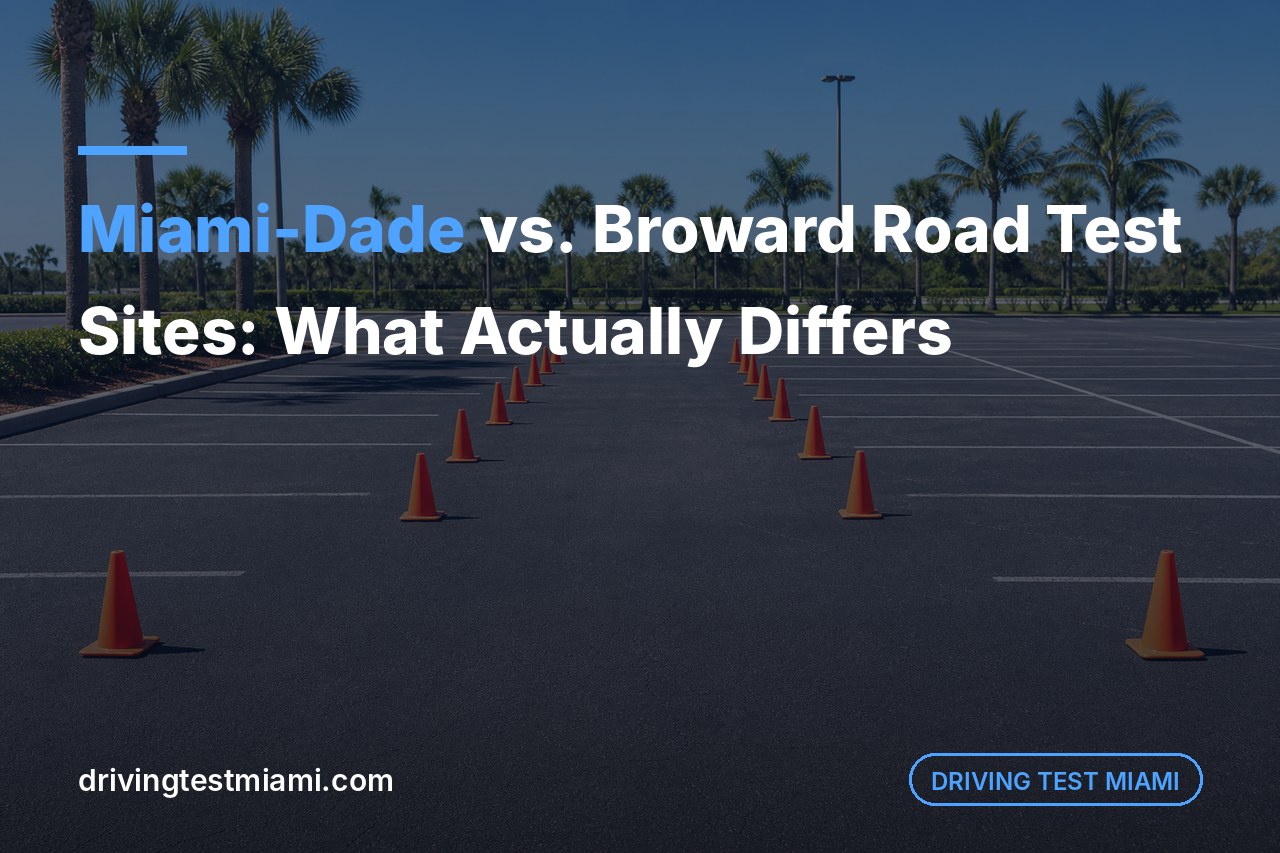
The off-road maneuvers take place in a designated area at the test site before the on-road driving begins. Many test-takers study a maneuver that is no longer on the Florida road test: parallel parking was removed from the Class E skills test entirely and will not appear. Time spent drilling it is not wasted for real-world driving, but it will not be evaluated.
The maneuvers that are required:
Three-point turn. The examiner directs you to reverse direction within a designated space. This tests controlled use of forward and reverse gears with deliberate steering in a confined area. Check mirrors and look over your shoulder at each reversal point, not just forward.
Straight-line backing. You are asked to back the vehicle in a straight line across a set distance. Here is the specific instruction the examiner gives: do not use the rearview mirror or backup camera. You must turn and look over your right shoulder through the rear window for the duration of the maneuver. Using the camera or mirror is a scored error. The point is to demonstrate direct rearward visibility, not camera reliance - a distinction examiners take seriously.
Straight-in parking. Pull the vehicle forward into a designated parking space so that it sits fully within the marked boundaries. Wheels outside the space or the vehicle body crossing the lines count as errors.
Parking on a grade. The examiner asks you to park on an uphill grade and a downhill grade, both with and without a curb present. Each combination has a specific correct wheel position to prevent a parked vehicle from rolling. Know all four scenarios - uphill with curb, uphill without curb, downhill with curb, downhill without curb - and practice them in sequence so the decision is immediate, not a memory exercise during the test.
Emergency stop. At a point during the off-road phase, the examiner issues a sudden command to stop. The expected response is immediate, controlled braking to a full stop without losing directional control. This tests reaction time and brake modulation, not emergency skid technique. A smooth, decisive stop is the goal.
The Road-Driving Portion: How the Examiner Directs You and What They Watch
After the maneuvers, the examiner directs you out of the site area and onto public streets. The on-road portion covers roughly a mile and a half to two miles of public road and typically takes between eight and fifteen minutes, depending on traffic and the specific route at that site. The route varies by location but is designed to include intersections, turns, and normal traffic conditions.
The examiner gives directions one at a time: 'At the next light, turn right,' or 'Continue straight through the intersection.' Instructions arrive with enough lead time to respond correctly. There are no trick commands and no deliberately confusing instructions. If a direction seems unclear, ask before the turn rather than guess.
What the examiner records on the clipboard while you drive:
- Turn signal timing - Florida law requires signals to be activated well before any turn; examiners mark deductions when signals go on too late. Check the Florida Driver Handbook for the required distance, and apply that standard on every turn, including into parking areas
- Intersection behavior - coming to a full stop at the stop line rather than the crosswalk edge or beyond; scanning cross-traffic before proceeding even when the signal is green
- Speed management - maintaining a reasonable speed for conditions; driving significantly below the posted limit as a test-day hedge is itself a deduction
- Lane positioning and lane changes - checking mirrors, turning your head to check the blind spot rather than relying on mirrors alone, signaling before changing lanes, maintaining consistent lane tracking
- Following distance - leaving adequate space behind the vehicle ahead
- Right-of-way - yielding correctly at uncontrolled intersections and when merging
The examiner does not prompt you to correct errors while driving. They observe and record. Drive as you would on any routine trip - not tentatively, not theatrically.
How Florida Scores the Test: Disqualification vs. Point Deductions
Florida's Class E road test uses a pass/fail system for the on-road portion, and no public numeric score is revealed to the applicant. The result is a pass or a fail. Understanding the difference between what ends the test immediately and what results in a deduction is important, because these are not the same category of error.
Certain errors trigger automatic disqualification and end the test on the spot:
- Any collision, however minor
- Running a red light or stop sign
- Failing to yield right-of-way
- Exceeding the posted speed limit beyond the state's defined threshold - consult the Florida Driver Handbook for the current specific margin
- Any situation requiring the examiner to physically intervene to prevent a dangerous outcome
If any of these occur, the examiner directs you back to the test site immediately. The test is over at that moment. Other errors - a late turn signal, a minor lane drift, stopping slightly past the stop line - are recorded as deductions. Enough deductions produce a failing score at the end, but the test continues while they accumulate. Many test-takers confuse these two categories, assuming that any serious moment during the drive automatically fails them. That is not how the system works. Deductions and disqualifications follow entirely different mechanics.
Getting Your Result on the Spot: What the Examiner Says and Does
When the on-road portion ends and you return to the test site, the examiner does not hand you a result slip and wave you off. The procedure includes a debrief before any result is issued. The examiner walks through whatever errors were recorded during the test - deductions and, if applicable, the disqualifying event - before stating the outcome. This happens regardless of whether you passed or failed.
This debrief is specific and factual. It is not a general impression of your driving; it is an accounting of what was marked, where, and why. Even on a passing result, the examiner notes deductions so you understand what to continue working on. If you failed, the explanation identifies exactly what caused it. Ask questions if something is unclear. You will not have another opportunity to hear this specific feedback from this examiner.
After the debrief, the examiner officially issues the result and you return to the counter inside for processing - the next steps depend on whether you passed or failed.
If You Pass: Getting Your Temporary and Permanent License
A passing result does not mean you leave with a plastic license card in hand. The permanent card is produced centrally by the state and mailed to your address on file. What you receive the same day, at the tax collector office or DHSMV counter, is a temporary paper license. It is a legal document, not a receipt. It serves as your proof of driving authorization while the permanent card is processed and shipped.
Keep the paper temporary license with you any time you drive until the plastic card arrives. The permanent card typically reaches you by U.S. mail within about a week to ten business days of the test date, though processing and delivery times can vary. If the card has not arrived within a reasonable window past that estimate, contact the FLHSMV or your local tax collector's office to check on its status before assuming it was lost.
There are fees associated with the licensing transaction at the counter window. The tax collector office handles these at the time of the result - bring a payment method. Check FLHSMV.gov or your local office for the current fee schedule, as amounts are set by the state and subject to revision.
If You Fail: Wait Time, Retake Fee, and How to Rebook in Miami-Dade
Failing the road test is not the end of the process. It is a setback with a defined path forward. Florida imposes a mandatory minimum waiting period before a retest appointment can be booked - the current requirement is published at FLHSMV.gov and is the baseline you must clear before rebooking. A retake fee also applies at the time of the new test; check the current amount with your local FLHSMV office or tax collector rather than relying on a figure from an online guide, as fees change.
The practical wait in Miami-Dade typically runs well beyond the statutory minimum. Appointment slots at county test sites fill quickly, and availability in the metro area regularly extends the real delay to a week or more past the minimum waiting period. When you are ready to rebook, check both county tax collector offices and the approved third-party providers in the area - third-party sites sometimes have shorter lead times than county offices, and comparing both options can meaningfully reduce the gap between your first and second attempts.
Use the time between attempts deliberately. The examiner's debrief after a failed test is the most useful feedback you will receive. Go back and practice exactly what they named. If the failure was a disqualifying event such as running a stop sign, work specifically on intersection habits. If it was accumulated deductions for turn signals, build the habit of activating the signal earlier on every single turn, at every practice session, until early signaling is the default rather than an effort. The maneuvers are fixed, the driving standards are fixed, and the errors that produce failing results are predictable.
When you return for the retake, bring the same complete set of documents and arrive in a vehicle that will pass the safety inspection. A second appointment lost to a burned-out brake light or a missing insurance card is entirely avoidable - run through the full inspection checklist the night before, just as you should have done the first time.
Book your road test
Get a confirmed road-test date and a car in minutes.